

Last Updated: June 2026 | ⏱️ Read Time: 6 min read
Sources: Verified industry references (Google, Microsoft, OpenAI)
Why Affiliate Marketing is Your Best Side Hustle in 2026
Let’s be honest. Working a typical nine-to-five job while watching inflation eat away at your savings is exhausting. You want financial freedom, but starting a traditional business requires thousands of dollars in upfront capital. That is why you need a reliable affiliate marketing guide for beginners to show you how to generate passive income online with zero investment.
That is where affiliate marketing comes in. It is one of the most beginner-friendly business models because you do not need to create a product, manage inventory, or handle customer support. When you use this affiliate marketing guide for beginners, you simply promote someone else’s product, and when a sale happens through your link, you earn a commission.
What’s more, the digital landscape has shifted. In 2026, buyers are looking for genuine recommendations rather than pushy sales pitches. We have created this comprehensive affiliate marketing guide for beginners to help you build trust and solve real problems for your readers. To verify the popularity of digital side hustles, you can check industry statistics on HubSpot or read recent business reports on Google.
The Ultimate Affiliate Marketing Guide for Beginners
Starting out can feel overwhelming with all the technical jargon. However, the core mechanism is straightforward. We can break the entire business model in this affiliate marketing guide for beginners down into four simple steps:
- Step 1: Choose a Product: You find an affiliate product or service that aligns with your niche and sign up for their affiliate program.
- Step 2: Get Your Link: The merchant provides you with a unique tracking link (your affiliate link) that registers clicks and sales.
- Step 3: Share the Link: You create helpful content (like a blog post, video, or social media guide) and insert your affiliate link.
- Step 4: Earn Commissions: When a user clicks your link and completes a purchase, the system tracks it, and you get paid.
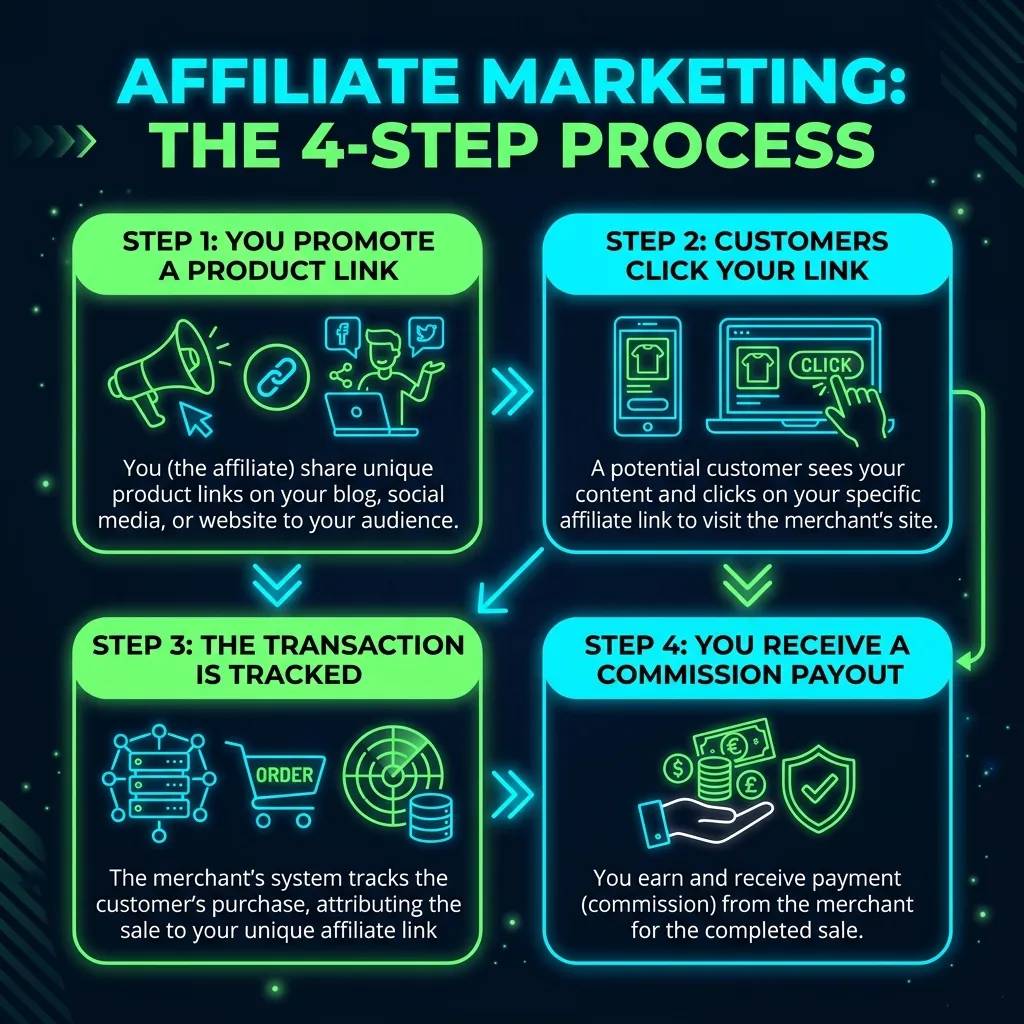
The bottom line is that you act as a digital matchmaker. Your primary job in this affiliate marketing guide for beginners is to connect someone who has a problem with a product that solves that problem. The tracking cookies ensure you get credited even if the user takes a few days to make the purchase.
Choosing Your Affiliate Niche Without Getting Overwhelmed
One of the biggest mistakes beginners make is trying to promote everything to everyone. This dilution makes it impossible to build authority in Google’s eyes or gain trust from readers. Any proper affiliate marketing guide for beginners will tell you that niche selection is your foundation.
First, look at industries that have high demand and solid profit margins. The finance, technology, digital marketing, and health sectors are evergreen spaces. Also, look at emerging trends like AI business software or remote work tools, as these areas are growing rapidly in 2026.
Second, pick a niche you are genuinely interested in. Writing articles and building an audience takes time. If you choose a topic solely for money, you will likely burn out before you see your first commission check. Focus on a niche where you can comfortably create helpful, detailed content week after week.
High-Paying Beginner-Friendly Affiliate Networks
To start promoting products, you need to join an affiliate network. These platforms host thousands of merchant programs, handle tracking, and guarantee your payouts. Here is a comparison of the top beginner-friendly networks in 2026:
If you are just starting out with this affiliate marketing guide for beginners, we suggest registering with Amazon Associates first. While the commissions are low, people already trust Amazon, making it much easier to get those initial sales. Once you gain confidence, you can explore ClickBank for digital courses or individual SaaS affiliate programs for recurring passive income.
How to Promote Your Links and Get Your First Sale
Once you have signed up for a network and selected a product, you need to get people to click your link. This is where many beginners struggle. Spamming your link in Facebook groups or comment sections does not work and will only get you banned.
Instead, focus on content marketing. Setting up a professional blog is the most reliable way to get high-quality search traffic. You can write honest product reviews, comparison guides, and helpful step-by-step tutorials that solve a user’s query. When readers find your content genuinely helpful, they are far more likely to buy through your link.
You can also leverage platforms like YouTube or Pinterest. Creating short video tutorials showing a software in action can build trust rapidly. Always place your affiliate links in the description box, making it easy for viewers to click through.
Smart Tools to Speed Up Your Success
To run a successful affiliate business, you need the right tools. Trying to save money by using free, clunky blogging platforms is proof of a short-term mindset. It will only hurt your brand image and Google rankings in the long run.
First, you need a reliable hosting provider. We highly recommend using Hostinger. It is fast, affordable, and handles traffic spikes easily. A slow website will push readers away before they even read your recommendations. Keep this in mind as you study this affiliate marketing guide for beginners.
Second, you need a funnel and landing page builder. Tools like Systeme.io allow you to capture email addresses and build automated email sequences for free. Building an email list is the ultimate key to passive income, as it allows you to promote products repeatedly to the same audience.
Mandatory Disclosures: Building Trust and Staying Safe
Trust is the most valuable currency in affiliate marketing. If you try to hide that you are earning commissions, your audience will notice, and they will leave. In 2026, transparency is not optional; it is required by law. As we explain in this affiliate marketing guide for beginners, building a clean and honest relationship with your readers is essential.
Always place a clear disclosure near the top of your articles. Be honest about your relationships with brands. Readers respect transparency and are often happy to support your work by purchasing through your link when you provide them with real, actionable value. You can read more about affiliate rules on the official FTC website.
Frequently Asked Questions (FAQ)
Do I need a website to start affiliate marketing?
No, you can start by sharing links on social media platforms or YouTube. However, we suggest building a blog as it gives you full control over your audience and brand. Free platforms can change their rules overnight, whereas your own website is a digital asset you own.
How much money does it cost to start?
You can start with very little. Your primary costs will be a domain name and web hosting, which cost only a few dollars per month. Many powerful marketing tools offer free plans for beginners, allowing you to scale as you make sales.
How long does it take to get my first commission?
This depends on your traffic and strategy. Some beginners get their first sale within a few weeks using social media. If you are relying on Google SEO traffic, it can take three to six months of consistent posting to see steady sales. Consistency is key.